

How to create personalized corporate gifts that resonate
TL;DR:
- Personalized gifts yield higher retention and a significant return on investment compared to generic options.
- Understanding objectives and audience segmentation guides meaningful and culturally relevant gift selection.
- Measuring campaign impact and refining strategies ensures long-term brand connection and gifting success.
Every event planner knows the feeling: you spend weeks sourcing gifts, only to watch recipients smile politely and set them aside. Forgettable gifts don’t just waste budget, they quietly undermine your brand’s credibility. The good news is that personalized gifts yield 45% higher retention and up to 12x ROI compared to generic alternatives. This guide walks you through every stage of the process, from clarifying your objectives and researching your audience to selecting meaningful items and measuring real business impact, so your gifts forge connections that last long after the event ends.
Table of Contents
- Understand your objectives and audience
- Research recipient preferences for deeper personalization
- Select and customize high-impact gifts
- Deliver an unforgettable gifting experience
- Measure impact and refine your gifting strategy
- Why authentic gifting is more than just branding
- Bring your personalized corporate gifting to life
- Frequently asked questions
Key Takeaways
| Point | Details |
|---|---|
| Know your audience | Segment and analyze recipients for gifts that feel genuinely tailored and relevant. |
| Leverage technology and meaning | Use data and advanced tools for scalable, personal touches that respect culture and emotion. |
| Prioritize quality over quantity | High-quality items, thoughtful packaging, and subtle branding maximize impact and appreciation. |
| Measure and refine | Track ROI, gather feedback, and keep evolving your gifting strategy based on real results. |
Understand your objectives and audience
Now that you understand why thoughtful gifting matters, let’s ground your efforts by clarifying goals and knowing your audience. Before you browse catalogs or brief a designer, you need a clear answer to one question: what should this gift accomplish? The answer shapes every decision that follows.
Start by defining your desired outcomes. Common objectives include:
- Client loyalty: Strengthen relationships with high-value accounts
- Employee motivation: Recognize milestones and boost morale
- Brand recall: Keep your name top-of-mind after events
- Lead conversion: Nudge prospects further down the pipeline
- Cultural connection: Celebrate shared values or regional identity
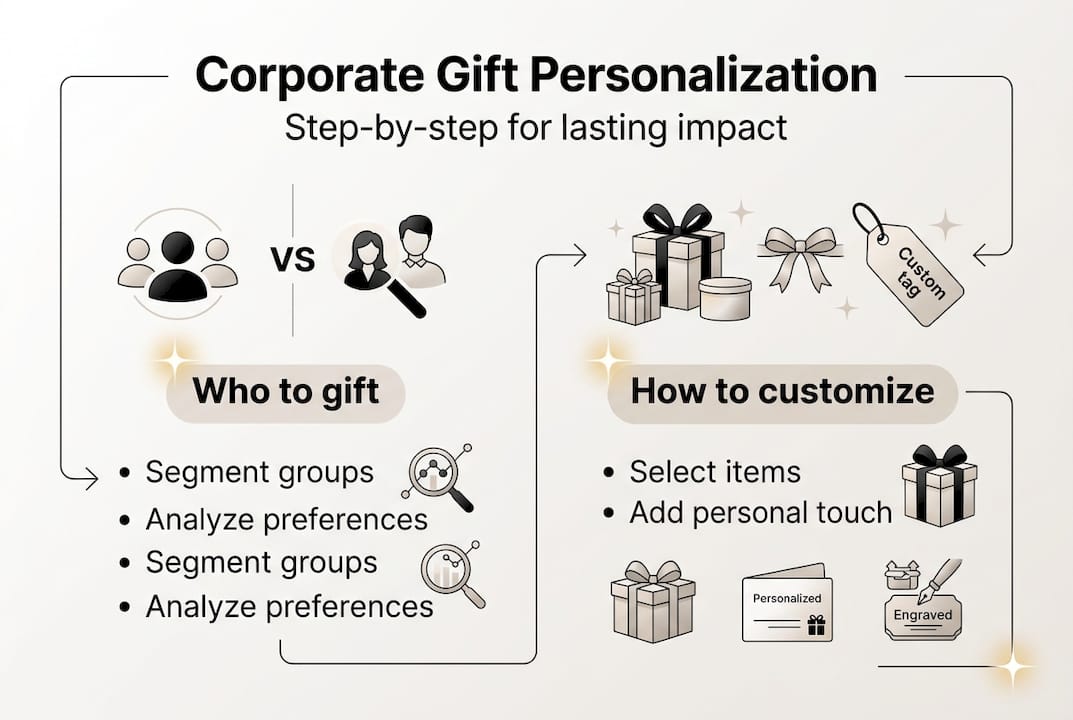
Once your goal is clear, segment your recipients. Not every client or employee deserves the same gift, and that’s not a value judgment, it’s a strategy. Segment by client revenue tier, geographic region, relationship length, or professional role. A long-term enterprise client in Tel Aviv has different expectations than a new partner in New York.
The step-by-step methodology for scaling personalization always begins with defining objectives and segmenting recipients before touching a single product. This prevents the most common mistake in corporate gifting: choosing a gift first and justifying it later.
Use this simple planning table to align your segments with objectives:
| Recipient segment | Primary objective | Personalization priority |
|---|---|---|
| Top-tier clients | Loyalty and retention | High: name, cultural fit |
| New prospects | Brand recall | Medium: quality and packaging |
| Internal employees | Motivation and recognition | High: milestone and role |
| Event attendees | Awareness and engagement | Low to medium: branded utility |
Understanding the personalized merchandise benefits of each category helps you allocate budget wisely. And when you treat gifts as meaningful personalized accessories rather than branded giveaways, recipients notice the difference immediately.
Research recipient preferences for deeper personalization
With your audience mapped, the next step is gathering actionable insights into what will truly delight them. Generic research produces generic gifts. You need real signals from real people.
Here’s a practical process for gathering meaningful preference data:
- Mine your CRM. Purchase history, event attendance, and past gift responses reveal patterns. Research recipient preferences using CRM data or segmentation before committing to any product category.
- Run short surveys. A three-question survey sent six weeks before an event gives you actionable input without burdening recipients.
- Ask account managers. Your sales and client success teams hold qualitative gold. They know which clients value sustainability, which ones collect branded accessories, and which ones prefer experiences over objects.
- Study cultural context. Regional holidays, professional norms, and personal values all influence how a gift lands. A pin celebrating a local landmark resonates far more than a generic logo item.
- Review engagement data. Email open rates, social shares of past gifts, and event photo tags tell you what recipients actually loved.
Cultural relevance deserves its own emphasis. Prioritize emotional resonance and utility when selecting items for culturally diverse audiences. A gift that acknowledges someone’s background or community signals genuine respect, and that signal is worth more than any logo placement.
For teams working with Israeli businesses or multicultural audiences, exploring keychain design for cultural fit offers a practical starting point. And for broader strategy, personalized marketing best practices from McKinsey confirm that relevance, not volume, drives lasting engagement.
Pro Tip: Ask one open-ended question in your pre-event survey: “What’s one thing that would make you feel genuinely appreciated by a business partner?” The answers will surprise you and transform your gifting strategy.
Select and customize high-impact gifts
Knowing your recipient preferences sets the stage for choosing and elevating the perfect gift. Selection is where strategy becomes tangible, and where most planners either win or lose recipient attention.
High-impact gift categories worth considering in 2026:
- Engraved accessories: Keychains, pins, and tags with recipient names or meaningful symbols
- Sustainable items: Recycled materials and eco-conscious packaging signal shared values
- Premium branded stationery: Useful, daily-use items with subtle logo placement
- Cultural collectibles: Enamel pins or magnets celebrating local icons or shared causes
- Wellness kits: Curated self-care items that communicate genuine care
Here’s how customization methods compare at scale:
| Method | Best for | Scale potential | Cost range |
|---|---|---|---|
| Laser engraving | Names, logos on metal | High | Medium |
| Enamel pin design | Cultural and branded icons | Very high | Low to medium |
| 3D printing | Unique shapes and prototypes | Medium | Medium to high |
| Digital printing | Full-color packaging and cards | Very high | Low |
Choose high-quality, useful items and customize with names, subtle branding, and thoughtful packaging. Quality signals respect. A poorly made item with your logo on it communicates the opposite of what you intend.

Subtle branding feels premium, and handwritten notes add perceived value that no technology can replicate. Resist the urge to plaster your logo across every surface.
For event planners exploring accessories, the custom keychains branding guide and custom pins branding impact resources show exactly how these small items carry outsized brand meaning.
Pro Tip: Order a small test batch before committing to volume. Send samples to three internal stakeholders and ask for honest reactions. What feels premium in a product photo often tells a different story in person.
Deliver an unforgettable gifting experience
The final touch, the delivery, determines how memorable and effective your gifting efforts will be. A beautifully chosen gift in a plain brown box loses half its impact before it’s even opened.
Here’s a step-by-step delivery framework that maximizes emotional resonance:
- Design the unboxing experience. Use branded tissue paper, custom inserts, and a handwritten card. The unboxing experience boosts impact dramatically, especially when recipients share it on social media.
- Time your delivery strategically. Sending gifts only at the holidays puts you in a crowd. Surprise recipients at unexpected moments: after a successful project, on their company anniversary, or during a challenging quarter.
- Personalize the message. Reference something specific to your relationship. “Congratulations on your product launch last month” beats “Happy holidays” every time.
- Follow up personally. A brief message two days after delivery, asking if the gift arrived safely, opens a natural conversation and deepens the relationship.
- Document your process. Track what you sent, when, and to whom. This data becomes invaluable for future campaigns.
“Timing beyond holidays drives connection. Gifts delivered at unexpected, meaningful moments generate far stronger emotional responses than seasonal sends.”
Personalized gifts see 45% higher retention and up to 12x ROI, but those numbers only materialize when the delivery experience matches the quality of the gift itself. The custom branding pins guide offers practical inspiration for creating gifts that feel complete from concept to unboxing.
Measure impact and refine your gifting strategy
After your gifts are sent, the true work begins: measuring results and improving for next time. Most planners skip this step, which is exactly why their gifting programs plateau.
Key metrics to track after every gifting campaign:
| Metric | What it measures | How to track |
|---|---|---|
| Retention rate | Long-term relationship health | CRM year-over-year data |
| Conversion lift | Pipeline movement post-gift | Sales team reporting |
| Net Promoter Score | Recipient loyalty and advocacy | Post-gift survey |
| Email open rate | Gifting campaign engagement | Email platform analytics |
| Social mentions | Organic brand amplification | Social listening tools |
Beyond numbers, collect qualitative feedback. A short follow-up survey with two or three questions tells you what recipients valued and what fell flat. This input directly shapes your next campaign.
Personalized gifting delivers 3-6x ROI, up to 12x, with 85% open rates on gifting-related emails. Those benchmarks give you a realistic target and a compelling internal business case when justifying your gifting budget to leadership.
Practical steps for continuous improvement:
- A/B test gift types across two audience segments and compare retention outcomes
- Rotate cultural themes annually to keep gifts feeling fresh and relevant
- Benchmark against industry data to understand whether your results are above or below average
- Build a gift memory log so you never repeat the same item to the same recipient
The planners who treat gifting as an ongoing program, not a one-time event, are the ones who build the strongest brand relationships over time.
Why authentic gifting is more than just branding
Having examined data-driven methods, let’s step back and challenge conventional wisdom with lessons from real-world success and failure. Here’s what we’ve seen consistently: most corporate gifts fail not because they lack customization, but because they’re built on assumptions rather than curiosity.
Planners often ask, “What gift represents our brand well?” The better question is, “What would make this specific person feel genuinely seen?” That shift in perspective changes everything. A beautifully engraved pin celebrating a recipient’s city, cause, or professional milestone communicates something no logo-heavy tote bag ever could.
Empathy and listening outpace budgets every time. We’ve seen modest gifts with deeply personal touches generate more gratitude and referrals than expensive generic packages. The creative keychain ideas that resonate most are always the ones rooted in a real story about the recipient, not just the brand.
At PinPerfect, we believe the most powerful gifts are born from humility: the willingness to ask, listen, and collaborate rather than assume. Even at scale, that mindset separates unforgettable gifts from forgettable swag.
Bring your personalized corporate gifting to life
Ready to put these steps into action? PinPerfect can help you craft the perfect gift experience, from concept to delivery.
At PinPerfect, we specialize in fully customizable enamel pins, keychains, magnets, and accessories designed to carry real meaning. Whether you’re celebrating a cultural milestone, reinforcing your brand identity, or recognizing your team, our in-house design team collaborates with you at every step. Explore our custom branded pins for culturally resonant options, or visit PinPerfect to browse the full collection. With worldwide shipping and wholesale options, we make it easy to give gifts that genuinely resonate, at any scale.
Frequently asked questions
What are the best personalized corporate gift ideas for 2026?
Premium engraved items, wellness kits, subtle branded accessories, and sustainable products are leading choices. Select high-quality, useful items aligned with your brand values and recipient preferences for maximum impact.
How do I ensure my gifts resonate culturally?
Research recipient backgrounds, use culturally sensitive designs, and avoid one-size-fits-all branding. Prioritize emotional resonance and utility to create gifts that feel personal and respectful rather than promotional.
What ROI can I expect from personalized corporate gifts?
Personalized gifting delivers 3-12x ROI and significantly improves recipient loyalty and engagement when paired with thoughtful delivery and follow-up.
Should I include my company logo on personalized gifts?
Opt for subtle branding over large logos to convey premium quality. Subtle branding feels premium and avoids the impression that the gift is purely self-promotional rather than genuinely thoughtful.
Recommended
- Personalized keychain design guide for Israeli businesses – PinPerfect
- What is personalized merchandise and how it benefits brands – PinPerfect
- Why use personalized accessories: meaning, identity, brand – PinPerfect
- Why order custom keychains for branding in 2026 – PinPerfect
- Personalized Jewelry: 50% More Emotional Value Explained – Eternal Carat